Water Line Repair in Dana Point
Your water supply line brings pressurized water into the house and to every fixture. When pressure drops everywhere, the meter keeps spinning, or part of the yard stays wet, we locate the affected section and explain whether a point repair or line replacement fits best.
Is It a Water Supply Problem or a Drain Problem?
Supply lines are pressurized and always full; drain and sewer lines carry used water away by gravity. The symptoms differ, and so does the fix.
| What you notice | Points toward the water supply line | Points toward drains or sewer |
|---|---|---|
| Pressure | Weak flow at every fixture, hot and cold | Pressure is normal; water just drains slowly |
| Water meter | Meter moves with all fixtures and appliances off | Meter is still when water is not in use |
| Wet areas | Clear water, wet even when no one is using water | Wet or odorous only after fixtures drain |
| Sounds | Hissing or running water with everything off | Gurgling as fixtures drain |
If your symptoms line up with the right-hand column, our sewer line repair page is the better starting point. For leaks inside the home's walls or under a slab, see leak detection and repair.
How We Evaluate a Main Water Supply Line
Each step narrows the search so the repair is planned around confirmed findings rather than guesswork.
Confirm the symptom
We check pressure at several fixtures and observe the meter with water use stopped, establishing whether the problem is on the supply side and how active any leak is.
Identify the affected section
Using the main shutoff, branch valves and fixture isolation, we determine whether the issue lies on the service line between the meter and the house, at the main valve or regulator, or within the home's distribution piping.
Evaluate the line and its condition
We consider the pipe material, visible condition, history of failures and the symptoms observed to judge whether the problem is isolated or part of broader wear.
Assess access
Where the line runs, how deep it may be, and what sits above it, such as landscaping, a walkway or a driveway, all shape how the repair can be carried out.
Recommend and confirm the plan
You receive a clear explanation of the findings, the repair options and what each involves before any work begins.
Some supply problems turn out to be inside the house rather than on the service line, such as a failing valve, a single corroded section, or a fixture with a clogged aerator that only seems like a pressure issue. Following the sequence keeps us from recommending line work that the situation does not call for.
How Valves, Pressure and Location Change the Next Step
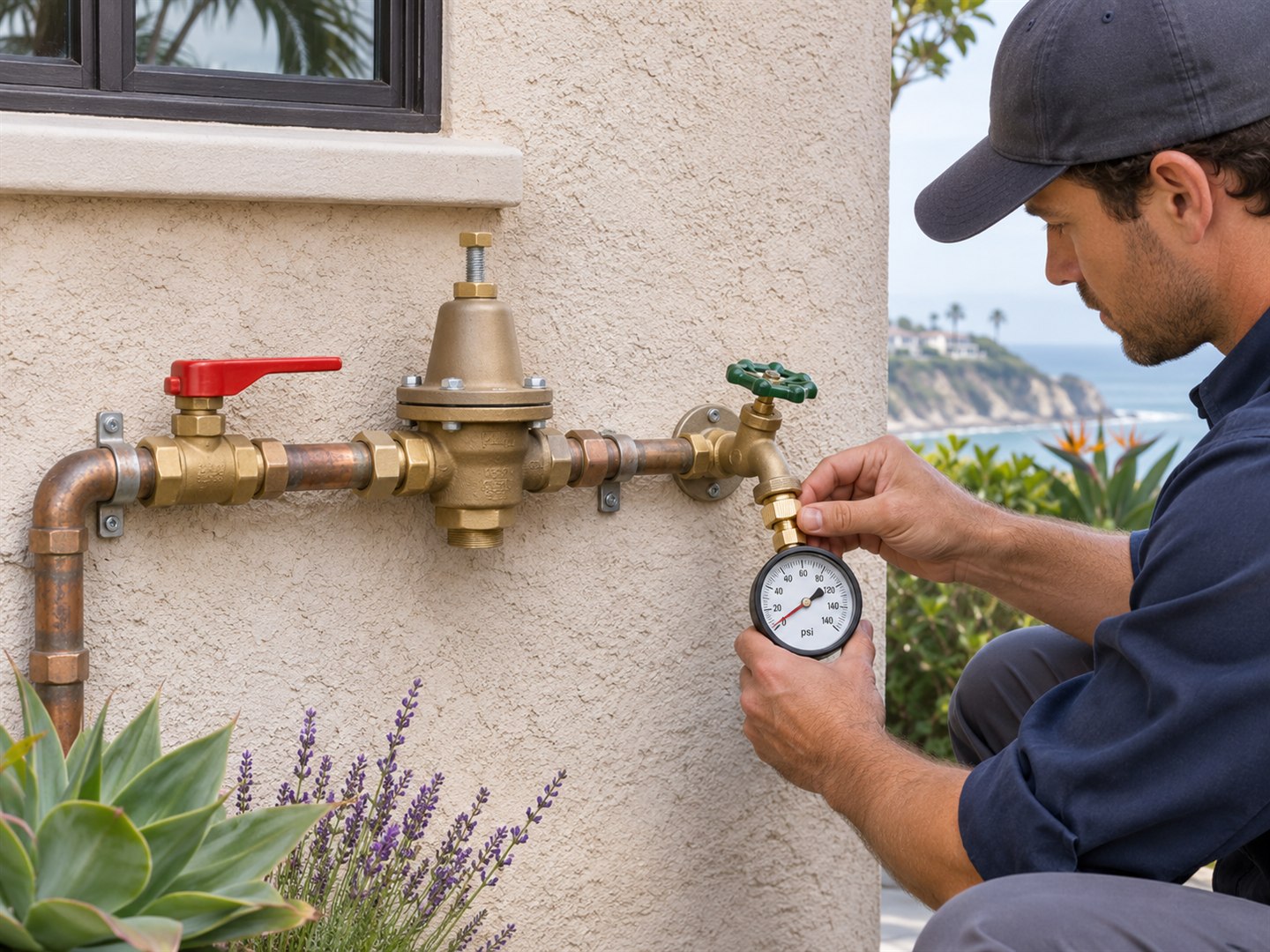
Not every pressure problem is a broken pipe. A partially closed or failing main valve, or a pressure regulator that is no longer holding its setting, can reduce or raise pressure across the whole house. These components are checked early because they are often simpler to address.
Location matters just as much. A leak on the service line outside the home involves different access than one where the line enters the house, and a problem on the utility side of the meter is generally not something a homeowner's plumber repairs.
- Know where your main shutoff is and make sure it turns
- Note whether low pressure affects hot, cold or both
- Do not dig to expose a buried line; utilities and other lines may share the route
Point Repair or Line Replacement?
A point repair may be enough when…
- The failure is isolated to one fitting or a short section
- The remaining pipe appears in good condition
- There is no history of repeated leaks on the same line
- The damaged area can be reached with reasonable access
Replacing the line is worth discussing when…
- Leaks have recurred at different points along the line
- The pipe shows widespread corrosion or deterioration
- Low pressure is caused by restriction throughout the line
- Repeated repairs would mean repeated digging in the same area
Who is responsible for which part of the line
Responsibility for a water service line can depend on where the problem is located relative to the meter and on the rules of the applicable water utility. In condos and townhomes, an association may handle shared piping. We help you understand what applies once the location is confirmed.
Pressure Dropping or the Meter Still Moving?
Call and tell us what you are noticing. We will help you work out whether it is the supply line, a valve or something else.
Questions About Water Supply Lines
Why is my water pressure low everywhere in the house?
Whole-house low pressure can come from a partially closed or failing main valve, a pressure regulator problem, a leak on the service line, or restriction inside older pipe. Checking valves and pressure first helps narrow it down.
There is a wet spot in my yard that never dries. Is it my water line?
It might be. Clear water that persists when irrigation is off can point to a supply leak, while odor suggests a sewer issue. Meter observations help confirm whether the supply line is involved.
Can I keep using water while a supply line leak is diagnosed?
For a slow leak, often yes, though it is wise to limit use. If water is surfacing quickly, pressure has dropped sharply, or damage is spreading, closing the main shutoff is the safer choice.
How do I know whether the problem is on my side of the meter?
Locating the affected section is part of the evaluation. Once we know where the problem is, we can explain how it relates to the meter and the applicable utility rules.
Related Plumbing Services
Supply line work is one part of the home plumbing services we provide in Dana Point.
Request a Water Line Evaluation
Call to describe the pressure, meter or wet-area symptoms. We will locate the affected section and walk you through the repair options.